


Hanuš Schwaiger (1854-1912)
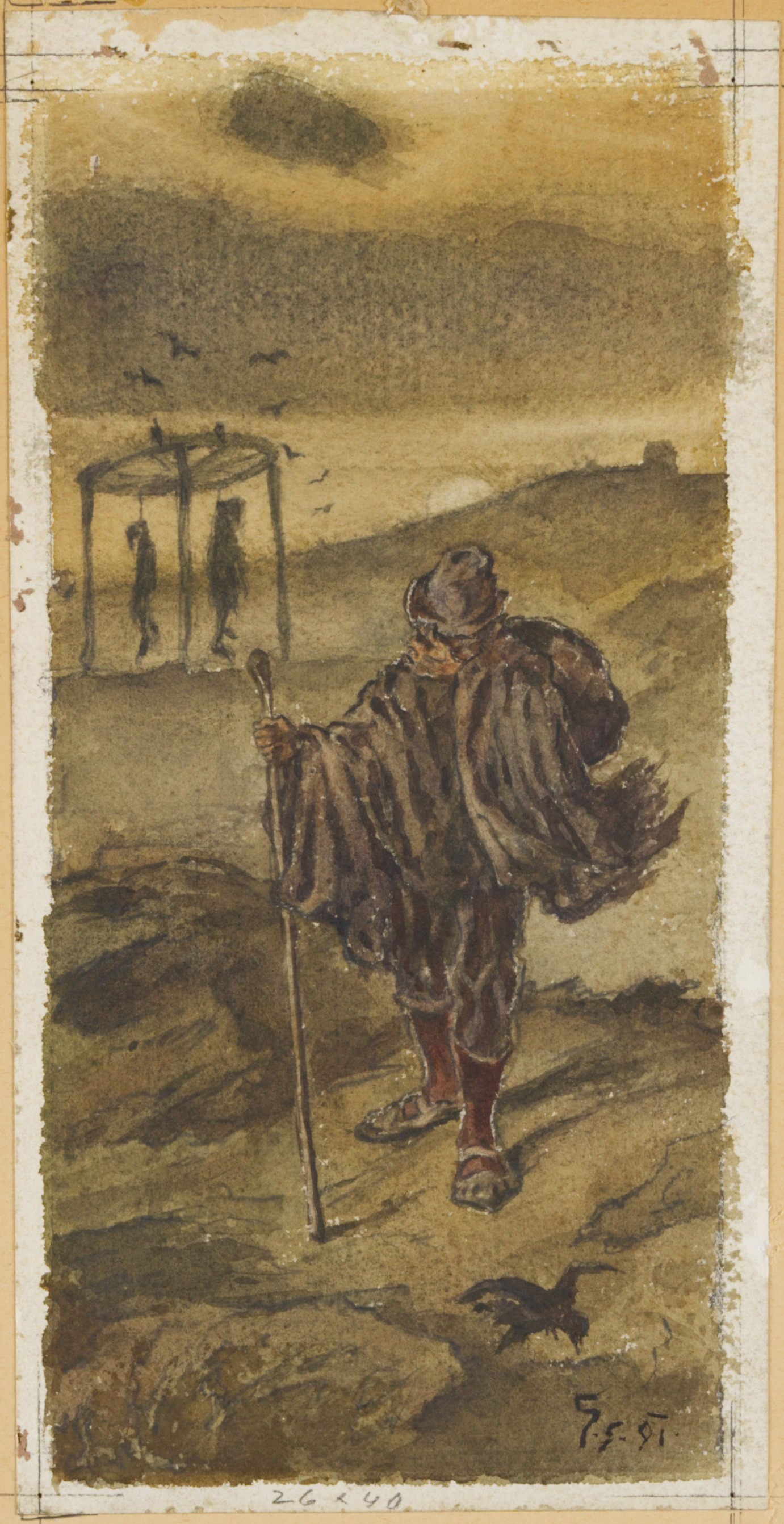
WAYFARER PASSING A GALLOWS WITH HANGED MEN
1891
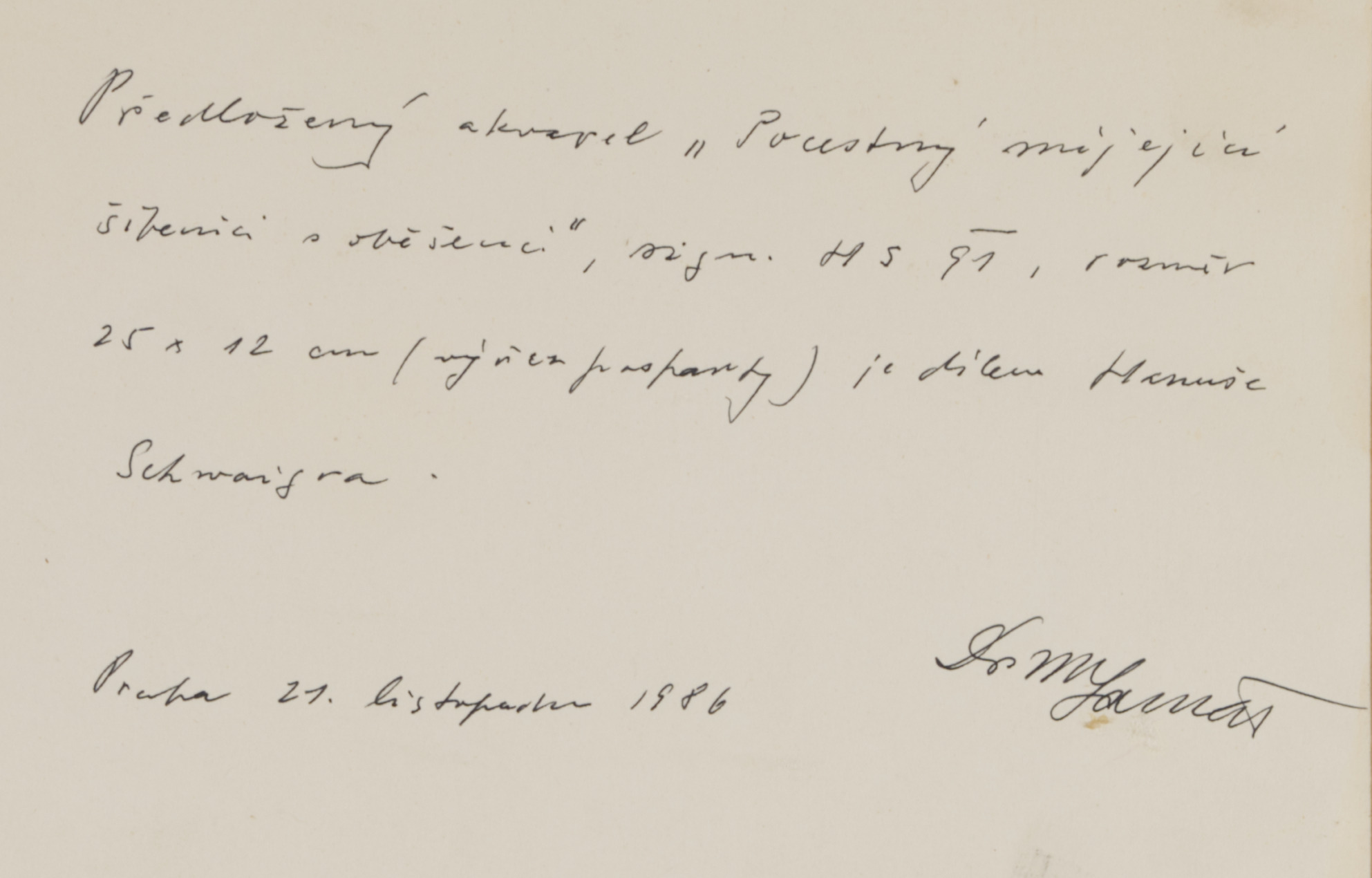
Watercolour on paper, 27x13.7 cm (38.2x25.5 cm), mounted on cardboard, signed and dated lower right "H. S. 91", accompanied by a note reading "Předložený akvarel ,Pocestný míjející šibenici s oběšenci´ sign HS91, rozměr 25x12 cm (výřez z pasparty) je dílem Hanuše Schwaigera. Praha 21.listopadu 1986 Dr. M. Janás" (confirmation of Hanuš Schwaiger`s authorship by Dr. M. Janás, Prague, 21 November 1986).
A stooped wayfarer in a billowing cloak, with a staff and a bundle on his back, walks through a bleak, windswept landscape. Behind him on a hill stands a gallows with hanged men, above which ravens circle. One raven also sits at the wayfarer`s feet, as if accompanying him. Above the horizon the setting sun fades. The pilgrim does not look back at the gallows; he walks on, knowing what he knows.
For an artist of idiosyncratic fantasy and historical imagination who loved the figures of vagabonds, beggars and pilgrims moving on the margins of society and on the border between reality and fairy tale, this is an entirely characteristic theme. The gallows on the hill, the ravens and the setting sun give an ordinary journey the dimension of a memento mori. The wayfarer`s path leads past death, and his only companion is the raven, a bird of ill omen. Schwaiger`s inspiration by old Netherlandish art is evident, especially Bruegel and his rough poetry of poor people and gallows in the landscape. The narrow vertical format with framing lines suggests that the sheet may have been made as an illustration design. This watercolour from 1891 comes from the artist`s mature period and is among the characteristic examples of his fantastical, ballad-like vision.
Provenance: Vilém Trmal Collection
Published: Pavel Hájek, Výtvarné umění ve sbírce Viléma Trmala, Prague 2021, p. 54.
Premium is 22 % to hammer price.
 Loading higher resolution