


František Kobliha (1877-1962)
TRISTAN
1909
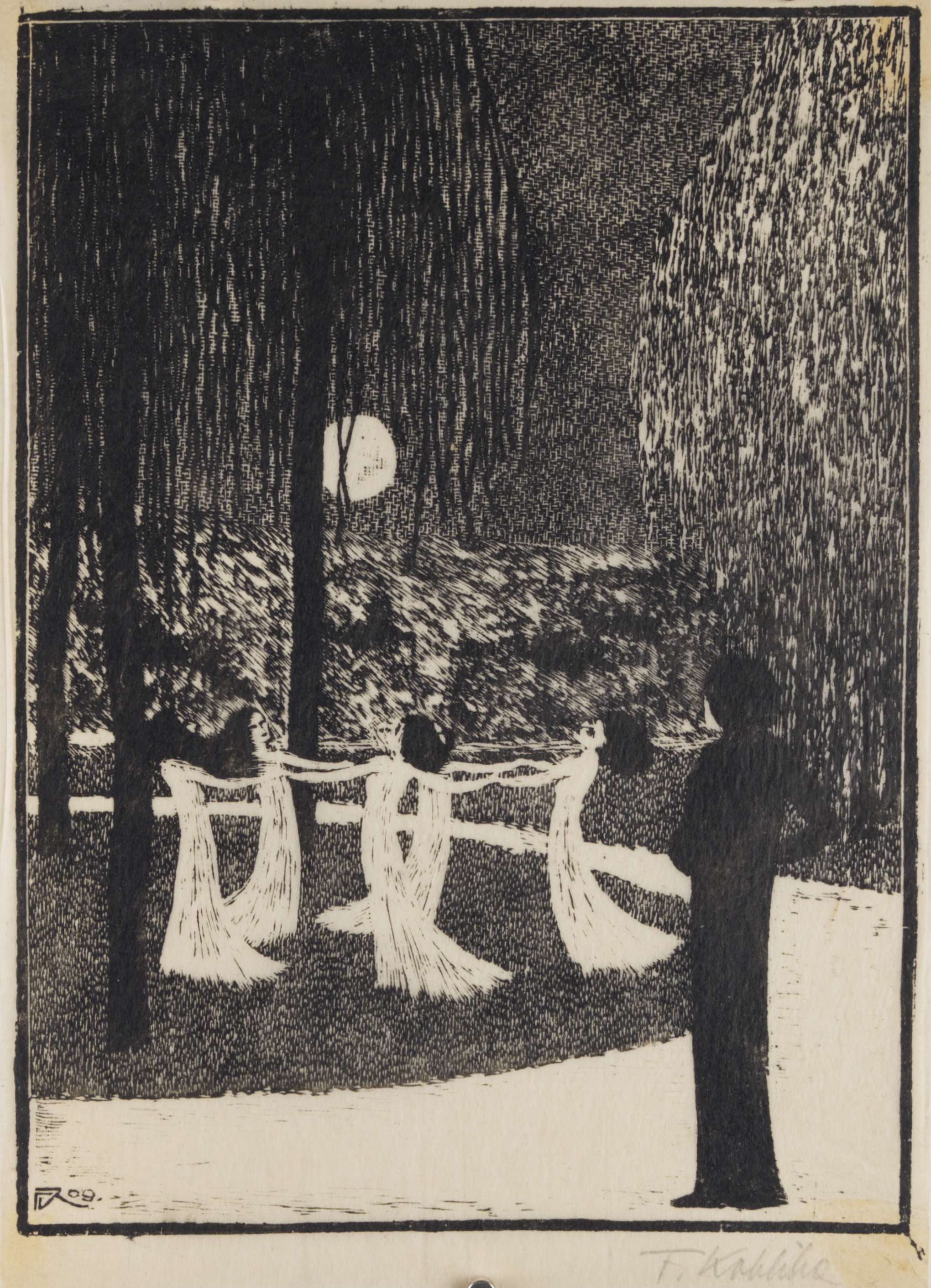
Woodcut on Japan paper, 20.8x15.1 cm, mounted on a sheet of heavier paper 22.1x15.7 cm, monogrammed and dated in the block lower left "FK 09", signed in pencil lower right below the printed area "F. Kobliha".
The motionless black figure of Tristan standing on the right watches the white female figures whirling in a dance. The sharp contrast between the white, ethereal dancers and the dark, earthbound figure expresses the gulf between dream and reality, longing and loneliness. Tristan here is not a victorious hero but a dreamer separated from his beloved, surrounded by night and moon with phantoms of love and death.
The sheet belongs to the peak period of Kobliha`s printmaking around 1909–1910. At this time he created his most famous symbolist cycles, such as Pozdě k ránu (Late Towards Morning), with their typical nocturnal poetics, the moon motif and the dark, finely cut woodcut through which light literally shines.
In the Trmal collection this sheet forms a counterpart to Konůpek`s scene of Tristan and Isolde, the motif of love sealed by a potion. For Konůpek love is a promise and intoxication; for Kobliha it is merely a nocturnal illusion and solitude. Both artists came from the same symbolist circle around the Sursum association, and each strikes a different chord in the Tristan myth: Konůpek promise and intoxication as a harbinger of betrayal, Kobliha night, illusion and loneliness as its consequence.
Visible traces of mounting in the corners of the sheet.
Provenance: Vilém Trmal Collection
Published: Pavel Hájek, Výtvarné umění ve sbírce Viléma Trmala, Prague 2021, p. 167.
Premium is 22 % to hammer price.
 Loading higher resolution