


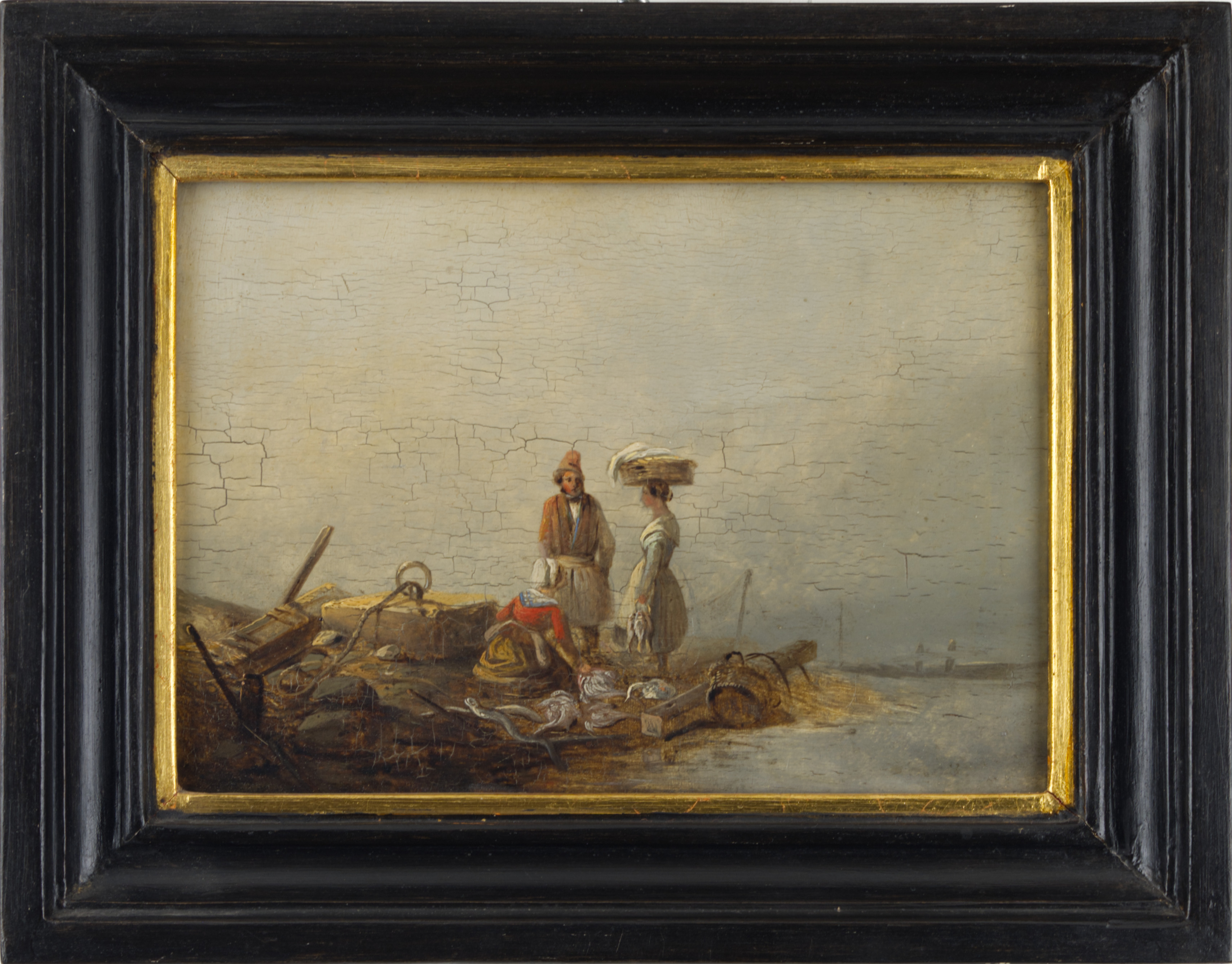
Hendrick Jacobsz. Dubbels (1621-1707)
FISHERMEN WITH THEIR CATCH ON THE BEACH AT SCHEVENINGEN
c. 1645–1650 (early Amsterdam period)
Oil on quarter-sawn oak panel with even growth rings, 17x24 cm (25.2x32 cm). Framed.
In the central part of the composition, discreetly integrated into the shadow at the bottom of the wicker basket, the cryptogram "HJD" (Hendrick Jacobsz. Dubbels) is inscribed with a fine brushstroke.
This small cabinet piece is an exceptionally refined example of Dutch genre marine painting of the mid-17th century. On the basis of the identified monogram "HJD" at the bottom of the wicker basket and rigorous stylistic analysis, this intimate work is attributed to the early oeuvre of the Amsterdam master Hendrick Jacobsz. Dubbels.
Such a small format is rare in the context of Dubbels`s later, more monumental work. The format and the hushed atmosphere of the scene, however, find a direct analogy in the circle of Dubbels`s teacher and mentor Simon de Vlieger (1601–1653), in whose Amsterdam workshop Dubbels worked in the 1640s. De Vlieger was renowned for his minimalist beach scenes on identically small oak panels (around 18x24 cm). The work offered here is thus tangible evidence of the period when the young Dubbels absorbed his master`s sense of intimate scale and low horizon and carried it over into his own independent works.
The composition is built on the essential Dutch principle of a very low horizon, with the dominant upper two-thirds of the surface taken up by a cool northern sky with an impenetrable screen of clouds. The light passing through the dense haze is reflected silvery from the sea in the background and models the action on the shore itself. The composition is marked by complete Dutch calm and compositional restraint. The action is limited to just three figures whose clothing and attributes are historically authentic to Dutch realities of the 1640s. The fisherman: a man in the robust utilitarian dress of a sailor, consisting of a waist-length jacket of coarse cloth (pijjekker), wide loose breeches to below the knee (wijd broek) and thick woollen stockings. On his head he wears a characteristic woollen sailor`s cap with a turned-up brim, which served as protection from sea spray.
The bareheaded woman: she represents a beach worker or fishwife (viswijf). On her head she carries a large flat wicker basket (ben) protected by a cloth cover. The fact that she is bareheaded and wears no cap corresponds to the practice of the time for women doing heavy work right at the surf. In her left hand she holds an interesting ethnographic detail – a historical tool called a visgand (or vishaak). This was a strong wire or bent willow rod joined into a ring with a handle, onto which fresh fish (herring or plaice) were threaded through the gills so they could be carried easily without damaging the flesh.
The kneeling woman in a cap: a seated or kneeling figure in a traditional white linen cap (hul), which identifies her as a married woman from the settled burgher or market class. This woman, on the ground directly on the sand, sorts the catch by size and quality for town customers.
The monochrome palette, built on earthy ochres, greys and silvery tones, is masterfully enlivened by a single local colour accent in the form of the red bodice of the kneeling woman. The exceptional collector`s value of this cabinet piece is underlined by the precisely described still life with the tools of the fishing trade in the left foreground (ropes, nets and a massive stone harbour block for mooring a boat). These details show the firm, miniature-like brush drawing typical of Dubbels`s early period, strongly informed by de Vlieger`s realism.
Condition B.
Condition consistent with the age of the support. The original quarter-sawn oak panel reflects the highest quality of material of the Dutch Golden Age, with regular even growth rings and high structural stability. The paint surface is covered with authentic dense micro-craquelure commensurate with the age of the support. No detectable later retouching.
Premium is 22 % to hammer price.
 Loading higher resolution